

Research is the fundamental pursuit and acquisition of new knowledge. In the next step, development is the initial specification and practical implementation.
Research & development is the cornerstone of many medium-sized mechanical engineering companies. The foundation of the mechanical engineering industry is based on the unique know-how created through research and development.
The research & development of new products and applications has always been a high priority at MACEAS. As early as the late 1990s, we set new standards in the leak testing technology of fuel tanks with ultrasonic gas bubble detection in a water bath. The automated and worker-independent leak test of fuel tanks with the help of the ultrasonic technology has become the standard procedure in the quality control for all well-known OEMs and Tier 1 suppliers in the automotive sector.
In the almost two decades that followed, there were a large number of new developments and research projects. In 2009 the first helium vacuum leak test system was developed and built in order to be able to meet the increasing requirements on leak rates and cycle times. The strong growth in the field of renewable energies, primarily wind energy, in the 2000s and 2010s also drove us towards fully automated production systems for wind power rotor blades.
Due to the energy and mobility transition, we are now dealing with the subject areas of hydrogen technology and battery applications. This involves the leak test of bipolar plates of fuel cells, cryogenic hydrogen cylinders and the end-of-line leak test of battery cells.
In the following we present our current research and development projects.
Our objectives:
- Sustainable and trendsetting products
- Customer benefit as a priority
- Protection of the environment and our climate
- Continuous development of the company
- Development of new business areas
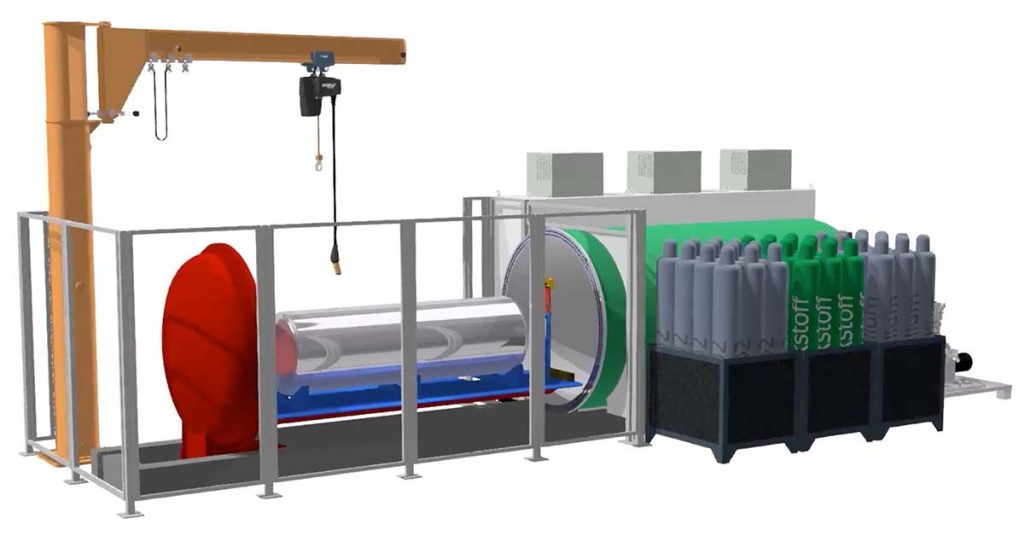
With the test device for cryogenic tanks developed by us, containers can be tested for leaks, but also experiments can be carried out in which the evacuation behavior can be tested.
Visit our microsite to get more information about the system we developed.
Learn more now!
Ultrasonic fault analysis for early detection in power transformers
In this project funded by the European Union and the federal state of Lower Saxony, a transformer ultrasonic fault analysis system is to be developed.
Power transformers are primarily used for energy transmission in electrical supply networks. For this purpose, oil-filled transformers are frequently used. Application sites can be substations or also wind power plants as well as grid transfer stations.
Due to the high availability of the power transformers located in the network that must be ensured and the associated high requirements on failure safety, various early warning systems as well as safety and protection techniques are used, such as for example the Buchholz relay or oil analysis. All methods have in common that they are dependent on increased outgassing of the transformer, that it must be completely taken out of operation, or that there is already noticeable influence on its functionality.
An early fault detection, for example via a gas-in-oil analysis (gas chromatography), is according to the current state of the art very complex, cost-intensive, and requires special expert knowledge. A localization of the fault is not possible with this method.
The ultrasonic fault analysis system offers the possibility to equip power transformers in a standardized and cost-efficient manner with an early fault detection protection. Through the comprehensive use of such an early detection method, impairments and thus possible failures can already be detected in the initial stage. A scheduled replacement or a corresponding maintenance of the transformers is thus no longer a challenge.
Furthermore, in addition to the early warning criterion and the simplified maintenance, the cost-effective and efficient verification of upcoming new transformer series before series use is also an important aspect of the ultrasonic fault analysis.
The learning-capable system of the ultrasonic fault analysis is trained with all standard scenarios of a power transformer. In clear distinction to these trained scenarios, the system can detect the changes within the transformer topology and determine defined fault cases arising in the foreseeable future.
Furthermore, it is added that the ultrasonic fault analysis is the only method that makes it possible to also localize a fault locally and it is in addition significantly faster than other methods. This means concretely that a fault can be narrowed down to a specified local area and that changes in the outgassing behavior of the insulation fluid of the power transformer can be detected immediately.
The ultrasonic fault analysis for early detection in power transformers makes use of a simple principle. A corresponding insulation fluid is contained in the transformers and when a defect is now developing, among other things gas inclusions/gas bubbles form in the fluid. The ultrasonic sensors detect the gas bubbles within the transformer topology and can assign these locally.