


Automated leak testing does not begin solely with the measurement. Test parts must be provided, securely picked up and positioned, guided through the testing process, evaluated, and then transferred to the next production step.
MACEAS connects these processes into a continuous, partially or fully automated workflow. Depending on the component, cycle time, variety of variants, and production environment, this results in independent test stations, automated manufacturing cells, or fully integrated systems. Mechanics, electrical engineering, control, operation, and data communication are coordinated accordingly.
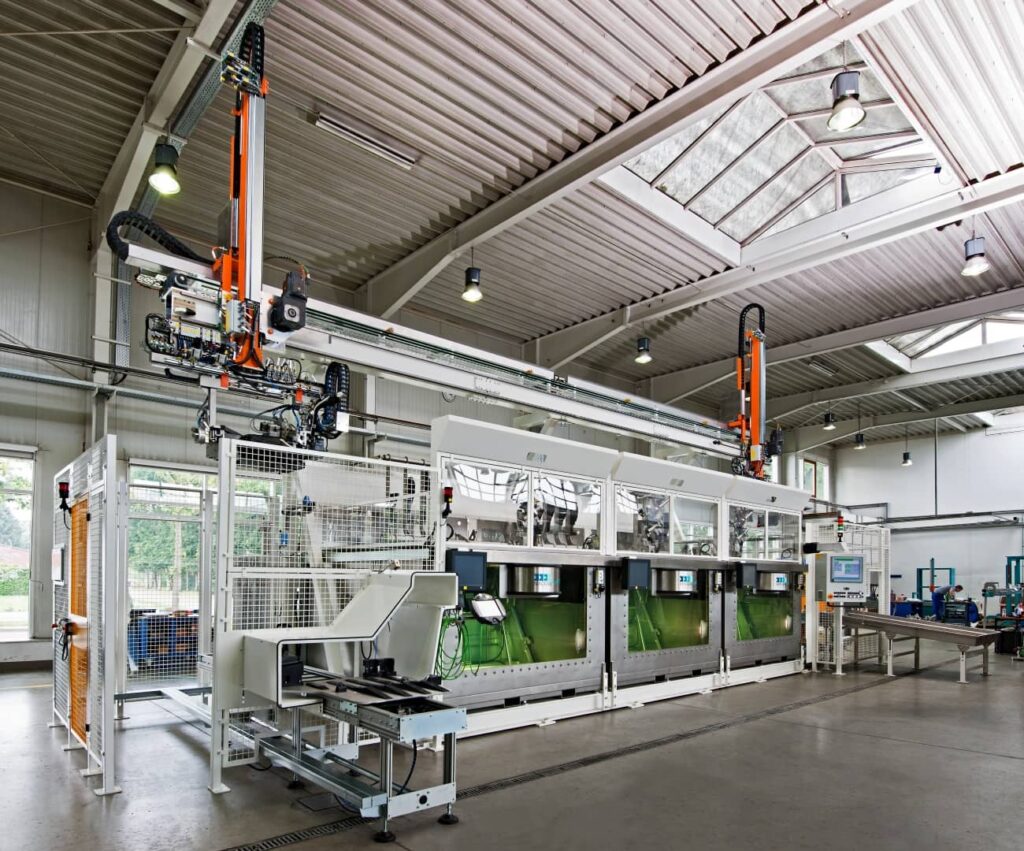
Short Cycle Times and High Throughput
Automated feeding, testing, and removal reduce manual steps and enable continuous production.
Reproducible Process Reliability
Every test specimen undergoes the defined testing process under consistent conditions, independent of operating personnel and reliably repeatable.
Continuous Process Integration
Part handling, leak testing, evaluation, and data transfer are seamlessly integrated into the production line and combined into a coordinated overall process.
When should you consider automating your testing processes?
Automated leak testing is particularly useful when high volumes, short cycle times, or specific requirements for process reliability and documentation must be met.
High Volumes and Short Cycle Times
If test parts need to be tested quickly and continuously, feeding, testing, and removal can be combined into a coordinated process.
Reproducible Test Results
If testing should always take place under the same conditions, independent of operating personnel, automation reduces manual influences.
Automated Material Flow
If test parts are to be provided, positioned, adapted, and then transferred to the next process step without manual intervention.
Seamless Documentation
If measured values, test results, and component data must be automatically recorded, uniquely assigned, and transmitted to higher-level quality systems.
Integration into Existing Production Processes
If leak testing is to be combined with upstream and downstream processing, assembly, or testing stations to form a continuous production line.
... and have your testing task evaluated
Automation tailored to testing methods and production processes
Helium
Automated
Helium Leak Testing
In helium leak testing, the actual testing process usually runs automatically, regardless of whether the test parts are fed manually or by means of a handling system. MACEAS combines the loading, adaptation, and sealing of the test part with the testing process steps of evacuation, helium background measurement, test gas pressurization, measurement and evaluation, as well as the subsequent transfer to the next process step.
Depending on the required cycle time, single or multiple test systems, additional test chambers, different article holders, and optional helium recovery can be included in the system concept.
Ultrasound
Automated Ultrasonic Leak Testing
In ultrasonic leak testing, the feeding, positioning, immersion, and removal of test parts can be combined with the actual measurement process. Simultaneous testing of multiple components in a water bath is also possible.
Throughout the entire measurement period, the ultrasonic system monitors the relevant test areas and localizes escaping gas bubbles. Measurement results are available in real-time and can be visualized, documented, and transmitted to higher-level systems via the plant control. The sensor technology can be integrated into both new test systems and existing production lines.
Electrolyte
Automated Electrolyte Leak Testing
Electrolyte leak testing is suitable as an end-of-line test for already filled and completely sealed battery cells. The cells are fed into the vacuum chamber, tested, and then controllably discharged from the testing process or transferred to the next production step.
Depending on cell format, throughput, and cycle time, single, multi-chamber, or batch concepts can be realized. Automated test sequences, the clear assignment of measurement results, and their transfer to higher-level quality systems enable seamless traceability within battery cell production.
Individual
Individual Machine and Plant Construction
MACEAS’s mechanical engineering expertise extends far beyond leak testing. Whether it’s a special fixture, handling system, automated manufacturing cell, or complete production line: MACEAS develops and implements customized solutions for industrial processing, assembly, conveying, and testing processes.
Implementation can be based on a customer specification, an existing design, or an initially only described task. Mechanics, electrical engineering, control technology, and programming are realized as a coordinated overall solution. Due to the high vertical integration, essential steps from design to manufacturing, assembly, and commissioning can be provided from a single source.
Automation along the entire production process
Our automation solutions do not end before or after the leak testing station. Upon request, we connect leak testing with upstream and downstream processing, assembly, and logistics processes. This creates a continuous solution tailored to your components, production processes, and quality requirements.Material Provision and Part Handling
- Material stocking and automatic provision of components
- Handling systems, e.g., using robots for insertion into molds, fixtures, or test stations
- Intelligent intermediate storage and buffering within the manufacturing process
- Automatic removal and transfer to the next processing step
- Storage and conveying technology for components and parts to be assembled
- Intelligent intermediate storage and buffering within manufacturing
Processing and Assembly
- Manual or automated deburring according to the respective fuel tank type
- Post-cooling devices with or without robot handling
- Assembly of pumps, lines, valves, and other components
- Interlinking of different processing and assembly stations
Marking and Quality Assurance
- Marking by label printing or laser inscription
- Marking and quality assurance
- Transfer of process data
(e.g., leak rate) - Traceability
- Interface Integration
- Integrated manual, partially or fully automated leak tests
- Integration of helium, ultrasonic, and electrolyte leak tests
- Process monitoring by quality assurance systems including operator guidance
- Acquisition and assignment of production and test data
In four steps to an
automated system
Your testing task.
Your automation.
A single-source solution.
Would you like to automatically feed test parts into and out of a testing process, expand an existing production line, or realize a completely new special machine? Talk to us about your task.
... and discuss your requirements with us
Frequently Asked Questions
Stages of Automation
What levels of automation are possible for a leak testing system?
Which steps of a leak test can be automated?
The provision and feeding of test parts, their identification, positioning, and adaptation, as well as the complete testing sequence, can be automated. The evaluation and documentation of measurement results, the removal of test parts, and their transfer to the next production step can also be included in the automation concept.
When is a partially automated solution sensible?
What distinguishes a fully automated testing system?
Which leak testing methods can be automated?
Both helium leak testing and ultrasonic and electrolyte leak testing can be integrated into partially or fully automated system concepts. The appropriate degree of automation depends on the test part, testing method, quantity, cycle time, and production environment.
Can multiple test parts be tested simultaneously?
System Concept and Integration
Can automated testing systems be integrated into
existing production lines?
existing production lines?
Can different product variants be tested on one system?
Testing systems can be designed for multiple product variants. This can include, for example, interchangeable article holders, adaptable test programs, or automatically recognized component types. Which conversion is required and whether it is manual or automatic is defined in the system concept.
How are test results documented and processed?
Can existing systems be retrofitted with extensions?
Does MACEAS also handle automation tasks
outside of leak testing?
outside of leak testing?
Planning, Implementation, and Economic Efficiency
How is the appropriate degree of automation determined?
How does automation affect cycle time?
When does automation become economically viable?
How does the development of an individual automation solution proceed?

Managing Director
Have your automation project evaluated
Describe your testing task and requirements to us. Together, we will determine the technically sensible and economically appropriate degree of automation.