


Test device
for
cryogenic tanks
For reliable testing of cryogenic tanks
Alternatives to the Combustion Engine
Electromobility will increasingly dominate the automotive market in the coming years, while vehicles with conventional combustion engines will be pushed back more and more.
For passenger cars, hybrid and purely battery-based solutions will be the primary drive technology in the near future, but the fuel cell and the use of hydrogen as a propulsion medium will also take on major importance in the future. Particularly in commercial vehicles and local public transport, but also in aviation, fuel-cell propulsion is a real alternative. Short refuelling times and sufficient ranges per storage cycle are the key advantages of this concept. If the hydrogen is produced using renewable forms of energy (e.g. wind power), the eco-balance is also positive – keyword green hydrogen.
Cryogenic tanks as storage for liquid hydrogen
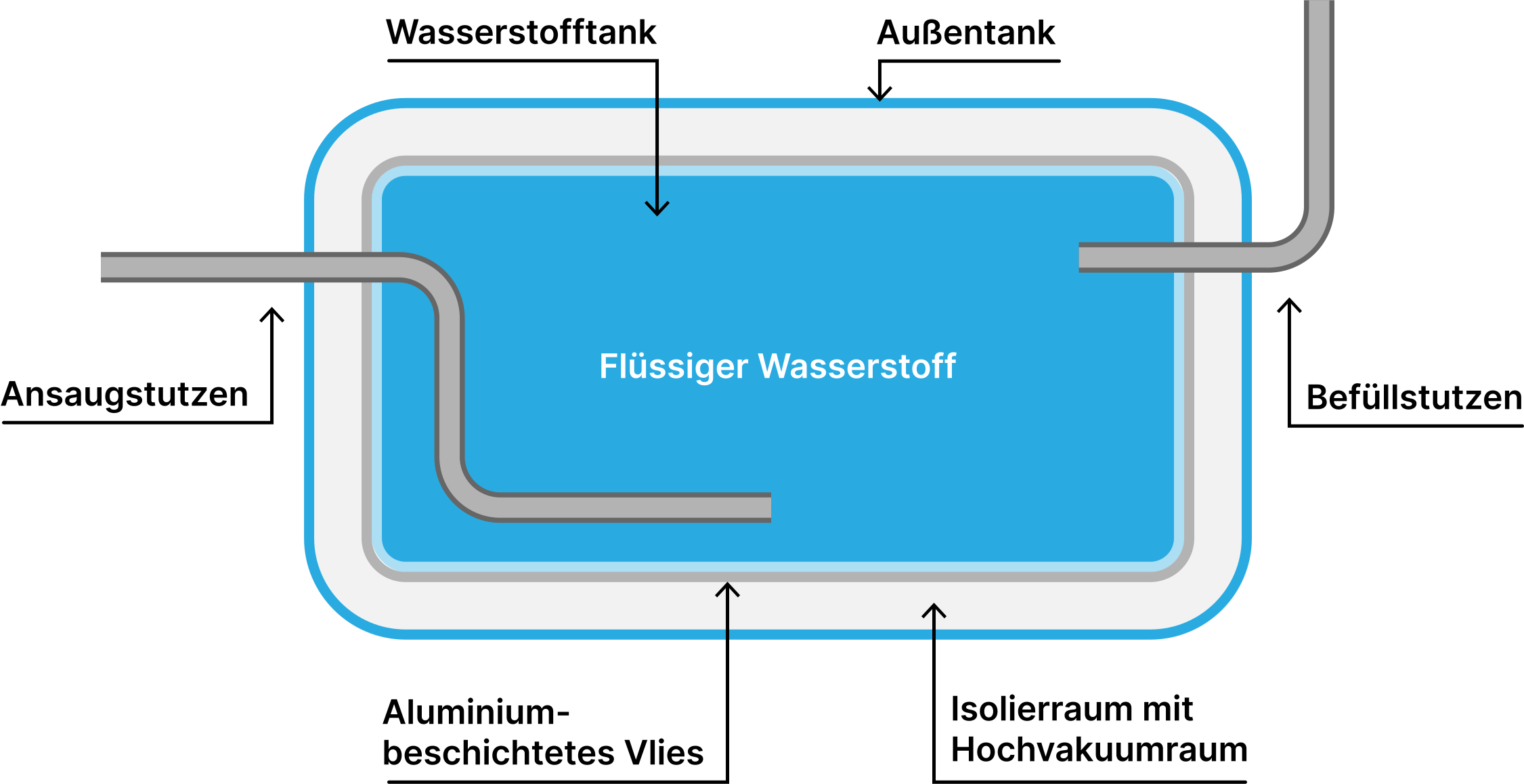
In addition to the possibility of storing hydrogen in gaseous form under high pressure, it can also be stored in liquid form and at low pressures in cryogenic tanks. Here, the quality of the insulation of the cryogenic vessel is decisive, because the boiling point of liquid hydrogen is approx. -253°C. At higher temperatures, the hydrogen changes into the gaseous state and then requires correspondingly more volume.
In order to be able to store liquid hydrogen for a sufficiently long time, cryogenic tanks are used. These tanks consist of the actual storage vessel, which is installed in a further vessel.
The outer skin of the storage vessel is often covered with an aluminium-coated fleece that keeps out radiant heat. Furthermore, a high vacuum is generated in the intermediate space, which is also intended to minimize heat transfer from the environment to the hydrogen tank.
In the ideal case, it is then possible to store liquid hydrogen over several days. A prerequisite, however, is that both the hydrogen tank and the surrounding shell have the lowest possible leakage rate. For this purpose, the components are tested in a helium leak testing device.
Test device for cryogenic tanks
During the development phase of a cryogenic tank, it is often also important to gain insights, e.g. into the evacuation behavior of a vessel.
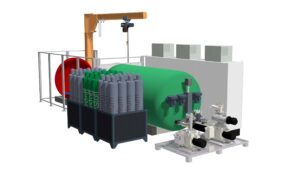
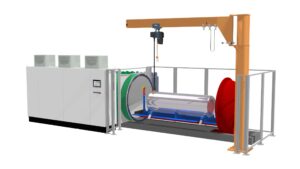
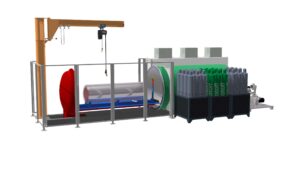
With the test device for cryogenic tanks developed by us, containers can be tested for leaks, but also experiments can be carried out in which the evacuation behavior can be tested.
For this purpose, the system is equipped with the following functions:
- Helium-Vakuum-Equipment zur Dichtheitsprüfung bis 1,0 ⋅ 10−6 mbar ⋅ l/s
- Gasversorgung für 2 unterschiedliche Gase (z.B. Stickstoff und Helium) mit der entsprechenden Ventiltechnik zum Spülen der unterschiedlichen Behälter
- Hoch-Vakuum-Pumpen zur Evakuierung des Isolierraums bis 1,0 ⋅ 10−7mbar
- Spezielle Vakuum-Verschlussventile, um das erzeugte Hochvakuum sicher abzudichten
- Heizvorrichtungen (bis 150°C) für …
- … die Prüfkammer
- … den Prüfling
- Flexibel programmierbare Funktionsbausteine für die Steuerung der Anlage, um unterschiedliche Prozessrezepturen realisieren zu können
- Visualisierung der Prozessdaten und Datenschnittstelle zu übergeordneten Datenerfassungssystemen
The test chamber has a sufficient size and can accommodate test specimens up to 800 × 800 × 3,000 mm (W × H × L). For easy loading and unloading of the test specimen onto the part holder, a slewing crane is available. After loading, the part holder is pushed into the chamber on a rail system and automatically docks to the supply facilities inside the chamber. After closing the chamber, the test process can be started.
Service: laboratory testing / prototype system
In addition to the option of purchasing this device, we also offer our customers the option of using a system at our site in Barßel for preliminary tests and test series. Particularly in the prototype phase, this can be a cost-effective way to gain initial insights that can be used for further development and optimization to series maturity.
We will be pleased to explain all details of this device to you in a personal meeting. We look forward to your inquiry.