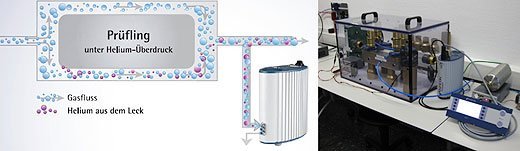

Helium leak testing
There are two different methods of helium leak testing. On the one hand, helium leak testing under vacuum, and on the other hand, helium leak testing in the atmosphere. While the detection of helium gas flowing out of the leak with a mass spectrometer always requires a high vacuum in the mass spectrometer (p < 10-4 mbar), helium sensors are now also available that no longer require a vacuum. However, much smaller amounts of helium can be detected with the mass spectrometer than is the case with other sensors.
Helium leak testing under vacuum
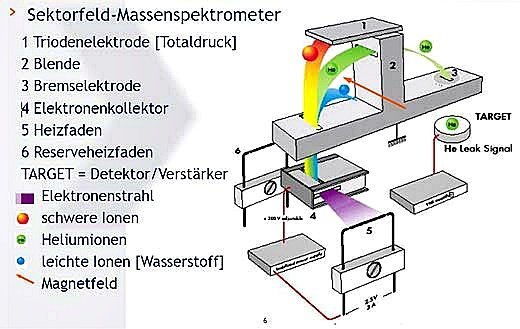
For this method, a mass spectrometer is required as a sensor. The helium atoms are ionized with the help of an electron beam. The now
electrically charged particles are directed onto a circular path in a magnetic field. The radius of the circular path depends on the mass of the particles. Only particles of a certain mass pass through the slit in the diaphragm. These then generate an electrical current at the detector.
Measuring principle – test system/device
The vacuum test chamber and the test part are evacuated. Then, the test part is charged with helium or a He mixture. Due to the previously existing vacuum in the test part, a uniform distribution of the test gas is achieved. After reaching a certain vacuum in the test chamber, the mass spectrometer is switched on and the measurement is performed. With a sniffer probe, the leakage can possibly be localized afterwards under atmosphere. Since only coarser leaks can be detected with the sniffer probe, it can happen that no leak is found. An alternative for leak localization is a re-test in a water bath.
Helium leak testing under atmosphere
Measuring principle – WiseTM sensor
With the help of a maintenance-free helium sensor (e.g., T-GuardTM), an increasing helium concentration in a test chamber can also be measured at atmospheric pressure. The actual sensor consists of a quartz membrane permeable only to helium and a permanently evacuated glass tube (cf. CRT television), as well as an anode ring and a cathode plate. At a concentration of 5 ppm helium, a current of 2-10-10A flows.
Measuring principle – test system/device
With the help of fans or circulation, in the event of a leak (helium flows into the chamber), the most homogeneous distribution possible is created in the chamber. This is necessary because otherwise leaks at different points would result in very different measurement values.